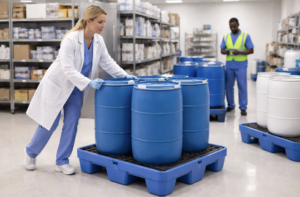
A modern healthcare campus is far more than exam rooms and patient beds. A single health facility may include pharmacies, laboratories, laundry areas, maintenance shops, utility rooms, environmental services storage, loading docks, and waste accumulation zones, all operating under intense pressure to protect people, preserve cleanliness, and maintain compliance. In that kind of environment, infrastructure choices that look small on paper can have an outsized effect on safety and operations.
That is exactly why Drum Pallets matter in healthcare facilities. They are not just industrial accessories placed under containers in the back of a building. In hospitals, outpatient centers, surgery centers, labs, and long-term care environments, they support spill control, cleaner storage practices, safer workflows, and stronger regulatory readiness. When the physical environment is being judged by patients, surveyors, staff, and administrators at the same time, secondary containment becomes part of the facility’s reputation for discipline and care.
Healthcare Facilities Operate with Tight Margins for Error
Healthcare buildings handle more hazardous and semi-hazardous materials than many people realize. Cleaning chemicals, disinfectants, maintenance fluids, pharmaceutical waste, lab chemicals, and other regulated materials move through the same campuses where vulnerable patients receive care. The risk is not limited to dramatic emergency events. Smaller leaks, improper storage, container failures, and messy staging areas can create exposure concerns, housekeeping burdens, odor problems, and operational disruption. The Centers for Disease Control and Prevention notes that healthcare facilities should dispose of medical waste regularly to avoid accumulation and that stored medical waste should be kept in labeled, leak-proof, puncture-resistant containers under conditions that minimize risk.
That guidance matters because healthcare environments are judged differently than ordinary commercial buildings. A warehouse can often isolate a spill as a logistics issue. A hospital cannot afford for a housekeeping problem in a support area to become a perception problem across the organization. Cleanliness, order, and risk control are part of the care environment itself. When containment is weak, even a non-clinical support area can create downstream consequences for staff confidence, survey preparedness, and administrative trust.
Containment Helps Facilities Stay Ready for Compliance
Regulatory pressure is one of the strongest reasons containment systems matter in healthcare settings. The Environmental Protection Agency has management standards specifically addressing hazardous waste pharmaceuticals generated by healthcare facilities and reverse distributors. That alone shows how specialized the storage and disposal environment has become for hospitals and related providers. Facilities are no longer dealing with a vague idea of “waste.” They are managing clearly defined streams that can carry different handling, labeling, and accumulation requirements.
A well-chosen containment pallet does not replace a compliance program, but it supports one in a visible and practical way. It helps keep drums elevated, contained, and organized. It reduces the likelihood that a small leak spreads across a floor. It gives staff a more controlled storage footprint. It also makes inspection routines easier because containers are not sitting directly on concrete in a way that hides minor seepage until it becomes a larger cleanup event. In a healthcare setting, that kind of prevention matters because one preventable storage problem can trigger a chain of corrective action, documentation, and operational distraction.
Spill Prevention Is About People, Not Just Property
The case for containment gets even stronger when viewed through the lens of worker protection. OSHA’s hazardous waste operations and emergency response guidance emphasizes preventing and minimizing worker injury and illness from exposure to hazardous substances. In healthcare, where clinical teams, facilities personnel, contractors, and environmental services staff often move through the same service corridors and back-of-house areas, exposure prevention is not theoretical. It is part of everyday operational responsibility.
A spill in a maintenance room or pharmacy support area does not stay neatly confined in the real world. It can create slip hazards, splash risks, cleanup downtime, and staff anxiety. It can also force temporary rerouting of traffic or require emergency response steps that interrupt normal operations. Becker’s Hospital Review has highlighted how hospitals work to reduce spills, splashbacks, and exposure incidents tied to waste handling. That same logic applies to drum storage. Secondary containment is not simply about catching liquid. It is about reducing the chance that one preventable event turns into a staff safety issue or a broader operational problem.
Material Flow in Hospitals Demands Better Storage Discipline
Healthcare facilities are complex movement systems. Waste, supplies, linens, pharmaceuticals, food service materials, and maintenance products all move through the same building ecosystem, often on tight schedules and through constrained service corridors. Health Facilities Management has pointed out that the flow of waste and materials in hospitals has direct implications for contamination control and operational efficiency, including the importance of dedicated holding areas and separation from patient care zones.
This is where containment pallets quietly earn their value. They create a more orderly staging area for drums and containers. They make it easier to standardize where certain materials belong. They help loading dock and support teams separate clean pathways from soiled or hazardous handling zones. They also improve visual management, which is important in environments where multiple departments share responsibility for back-of-house spaces. When storage looks disciplined, it becomes easier for teams to maintain disciplined behavior. That may sound simple, but in healthcare operations, consistency is often the difference between a smooth inspection and a corrective action plan.
Healthcare Sustainability Efforts Make Containment More Valuable
Healthcare leaders are under growing pressure to improve environmental performance while protecting patient care. Waste reduction, safer materials management, and better operational design are no longer side conversations. They are part of the broader mission of running resilient, efficient facilities. Healthcare Design has noted that healthcare organizations are actively looking at ways to reduce carbon impact and improve how materials and waste are handled across the built environment.
Containment supports that effort in practical ways. It can reduce floor contamination, lower the chance of waste stream mixing, and help teams preserve cleaner storage conditions that support better segregation. It also helps prevent the kind of avoidable cleanup and replacement work that adds cost without adding value. The American Hospital Association has highlighted the usefulness of medical waste audits as hospitals look more closely at what they generate and how they manage it. Facilities that want better waste data and better waste control need physical systems that support those goals. Secondary containment is one of those systems.
The Value Shows Up in More Places Than People Expect
In healthcare facilities, containment pallets can add value in pharmacy support rooms, central utility areas, environmental services storage, laboratory support spaces, mechanical rooms, loading docks, and regulated waste holding areas. They are especially useful wherever liquid materials are stored in drums or larger containers and where staff traffic is steady. Their benefit is not limited to catastrophic spill prevention. They help with housekeeping, inspection readiness, inventory discipline, and cleaner zone separation. Those are exactly the kinds of details that shape how well a healthcare facility runs day after day.
They also support a stronger culture of accountability. When a facility invests in the right physical tools, it sends a message that storage and handling standards matter. That message reaches facilities teams, environmental services staff, pharmacy operations, survey coordinators, and executive leadership alike. In a healthcare setting, culture is not built only through policy binders and staff education. It is also built through visible systems that make the right behavior easier to follow. Good containment does exactly that.
Conclusion
Drum pallets matter in healthcare facilities because healthcare environments cannot treat storage discipline as an afterthought. The stakes are higher. The regulatory environment is more complex. The people at risk include not only staff, but also patients, visitors, contractors, and the organization itself. Secondary containment helps facilities control spills, improve housekeeping, support safer workflows, strengthen compliance posture, and operate with the kind of consistency that healthcare demands.
For a hospital, clinic, lab, or long-term care provider, the smartest facility decisions are often the ones that prevent problems before they start. Containment pallets fit that standard. They protect floors, support inspections, reinforce safer handling, and help create a cleaner, more controlled physical environment. In healthcare, that is never a minor advantage. It is part of what responsible operations look like.