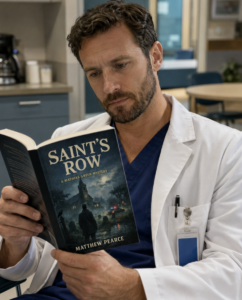
Healthcare professionals spend their lives close to the fragile line between suffering and survival. They see how trauma moves through families, how silence can become part of a person’s history, and how institutions can either protect the vulnerable or fail them in devastating ways. That is one reason Saint’s Row: A Mathias Green Mystery carries a deeper emotional weight for doctors, nurses, therapists, medical administrators, social workers, mental health professionals, emergency responders, and anyone who has worked in the healthcare world.
At first glance, Saint’s Row is a dark Southern Gothic murder mystery. It has atmosphere, suspense, secrets, danger, and a setting that feels heavy with history. But beneath the mystery is something healthcare professionals understand better than most: people are not only shaped by what happens to them, but also by what is hidden, ignored, mislabeled, or quietly accepted by the systems around them. That is where this story becomes more than entertainment. It becomes the kind of thriller that lingers.
Saint’s Row follows investigator Mathias Green as he arrives in Saint’s Row, Louisiana, to investigate the staged death of Pastor Gideon Vale. What appears to be one brutal murder soon opens into something much larger. The town begins closing ranks, records do not add up, old wounds resurface, and Mathias discovers a system built on fear, obedience, secrecy, and the suffering of children. For readers who work in healthcare, those themes hit differently because they echo many of the emotional and ethical realities professionals face every day. 📚
Why Healthcare Professionals Will Connect With the Emotional Core of Saint’s Row
Healthcare professionals are trained to look beneath the surface. A symptom is rarely just a symptom. A chart is rarely just a chart. A patient’s silence can matter as much as their words. Saint’s Row works in a similar way. The murder is the entry point, but the true story is hidden beneath layers of fear, generational trauma, institutional control, and long-buried truth.
That kind of storytelling naturally speaks to people who understand how trauma can present itself indirectly. Healthcare workers often encounter patients who carry pain that is not easily explained in one appointment, one diagnosis, or one conversation. A person’s history can live in posture, hesitation, anxiety, numbness, anger, withdrawal, or distrust. The official record may say one thing, while the human being standing in front of them reveals something much more complicated.
In Saint’s Row, Mathias Green must do what many healthcare professionals do instinctively: listen carefully, notice what others overlook, question what has been accepted as normal, and follow the evidence even when people in power would rather keep the truth buried. That makes the story especially compelling for readers who value observation, compassion, and moral courage.
This is also why the novel belongs in conversations about the best murder mystery books for professionals who want more than a simple whodunit. It is not only about solving a murder. It is about understanding how an entire community can become sick when silence is treated as loyalty and cruelty is protected by tradition.
A Thriller About Systems, Silence, and the People Who Fall Through the Cracks
One of the strongest reasons healthcare professionals will understand Saint’s Row on a deeper level is its focus on systems. In healthcare, outcomes are shaped not only by individual choices, but also by policies, staffing, documentation, communication, access, leadership, and culture. The same is true in Saint’s Row. The horror of the town is not limited to one villain. It is sustained by a structure.
That is what gives the book its Southern Gothic power. The decaying church, the closed community, the secrets passed from one generation to the next, and the fear surrounding Saint Bartholomew’s Church all create a setting where evil does not need to hide in the shadows. It survives because people explain it away, preserve it, or pretend they do not see it.
Healthcare professionals understand how dangerous silence can be. They work in a field where documentation matters, where missing information can change everything, and where hidden harm can continue if no one speaks up. Resources from the Centers for Disease Control and Prevention emphasize how systems, safety practices, and clinical responsibility are essential to protecting patients, workers, and communities. That same principle exists in mystery fiction in a more dramatic form: when systems fail, people suffer.
Saint’s Row turns that idea into a haunting narrative. Mathias is not simply chasing a killer. He is uncovering a pattern. He is looking at what records were hidden, what deaths were falsified, what children endured, and who benefited from keeping the truth out of reach. For healthcare readers, that structure feels meaningful because they know the difference between an isolated incident and a systemic problem.
Why Trauma-Informed Readers Will Find the Story Especially Powerful
Modern healthcare increasingly recognizes the importance of trauma-informed care. The Substance Abuse and Mental Health Services Administration has long emphasized that trauma can affect how people think, feel, trust, communicate, and respond to care. Saint’s Row is built around that kind of reality. The characters are not simply reacting to danger in the present. They are carrying the consequences of what has been done, hidden, justified, and inherited.
At the center of the mystery is Judah Mercy, a boy who stopped speaking after seeing too much and surviving people who wanted to define him. That detail gives the novel a powerful emotional center. His silence is not empty. It is evidence. It is protection. It is grief. It is survival. Healthcare professionals who work with trauma survivors, children, psychiatric patients, victims of abuse, or people in crisis will recognize how profound that silence can be.
Saint’s Row does not treat trauma as a quick plot device. It presents trauma as something layered, communal, and generational. The town itself feels wounded. Families are tied to secrets. Faith language is twisted into control. Records become weapons. Memory becomes dangerous. For readers in healthcare, these themes can feel unsettling because they reflect a truth many professionals already know: pain does not stay neatly contained. When ignored, it spreads.
That is what makes the book so gripping. It gives readers the suspense they expect from a murder mystery, but it also gives them psychological depth. It asks them to care about the people behind the clues. It asks them to see the victim, the witness, the child, the survivor, and the investigator as part of a larger moral landscape.
A Mystery Built for Readers Who Notice Details
Healthcare professionals are detail-driven by necessity. A slight change in breathing, a medication discrepancy, a missed note, a family comment, or a delayed response can matter. Saint’s Row rewards that same type of attention. The mystery unfolds through staged evidence, buried records, falsified deaths, secret confinement, and the slow realization that every answer points to something bigger.
That makes Mathias Green an especially appealing investigator for healthcare readers. He does not move through the story as a reckless action hero. He studies. He observes. He questions. He absorbs the atmosphere around him and recognizes when something is wrong beneath the surface. His investigation depends on patience, pattern recognition, and emotional intelligence.
Those qualities mirror skills healthcare professionals use constantly. The American Medical Association continues to report on physician burnout and the pressures facing clinicians, which shows how emotionally demanding the profession remains even when progress is made. A mystery like Saint’s Row offers a different kind of engagement for those professionals: a story that respects complexity, acknowledges moral fatigue, and still moves with suspense.
Healthcare readers do not need stories that simplify suffering. They often appreciate stories that understand that human behavior is complicated, institutions are powerful, and truth can be difficult to extract. Saint’s Row delivers that complexity while still giving readers the dark pleasure of a gripping murder mystery.
The Southern Gothic Atmosphere Adds Moral Weight to the Mystery
Southern Gothic fiction has always been effective at exposing buried corruption, family secrets, religious hypocrisy, decaying institutions, and the past’s grip on the present. Saint’s Row uses that tradition well. The Louisiana setting, the dying church, the storm waters, the old records, and the town’s suffocating silence create an atmosphere where the landscape itself feels like part of the investigation.
For healthcare professionals, atmosphere matters because environment matters. A person is shaped by surroundings, family systems, belief systems, social pressure, and access to help. The World Health Organization regularly highlights the importance of health workers and systems in meeting human needs across communities. Saint’s Row reflects a fictional version of what happens when a community’s system becomes morally diseased.
The Southern Gothic elements make that decay visible. The church is not only a building. It is a symbol of authority. The records are not only papers. They are proof of who was erased. The storm is not only weather. It is pressure building until the town can no longer hold its secrets together. That kind of symbolism gives the book a depth that healthcare professionals, especially those who work around grief, crisis, mental health, abuse, and family trauma, are likely to understand.
Why This Book Speaks to Burned-Out Professionals Looking for a Meaningful Read
Healthcare professionals often carry emotional weight long after a shift ends. They may be tired of shallow entertainment that ignores the depth of human suffering, but they may also not want a textbook or another professional article after a demanding day. Saint’s Row offers something in between: a suspenseful, atmospheric mystery with enough psychological and moral substance to feel meaningful.
Workforce strain is a major topic across the healthcare world. The American Hospital Association continues to track workforce shortages, while the Association of American Medical Colleges has reported projected physician shortages in the years ahead. Healthcare professionals are working in a field where demand, stress, staffing, and emotional burden remain constant concerns. A novel like Saint’s Row gives them a story that does not insult their intelligence or minimize darkness.
Instead, it offers a mystery that understands burden. Mathias Green enters a town filled with people who are afraid to speak, records that were meant to stay buried, and a child whose silence says more than words could. The story gives readers danger, tension, and atmosphere, but it also gives them something emotionally recognizable: the fight to protect the vulnerable when powerful people want the truth erased.
That is the kind of story that can feel strangely restorative. Not because it is light, but because it takes moral seriousness seriously. It gives readers a protagonist who keeps looking. It honors the idea that hidden suffering matters. It suggests that truth, once uncovered, can begin to break the machinery of cruelty.
Conclusion: A Murder Mystery Healthcare Professionals Will Feel, Not Just Read
The Southern Gothic Thriller That Healthcare Professionals Will Understand on a Deeper Level is more than a fitting title for Saint’s Row. It captures why this novel has the potential to resonate with a very specific kind of reader. Healthcare professionals know what it means to look closely, to listen when others dismiss, to recognize trauma beneath silence, and to confront systems that do not always protect the people they should.
Saint’s Row: A Mathias Green Mystery brings those realities into a dark, atmospheric murder mystery filled with secrets, danger, and psychological depth. It is a story about a town built on obedience, a church hiding something rotten, records that reveal more than people want known, and an investigator who refuses to look away. For doctors, nurses, therapists, social workers, emergency responders, healthcare administrators, and anyone who has spent time near human suffering, that kind of story reaches beyond entertainment.
It is suspenseful. It is haunting. It is morally charged. It is the kind of mystery that asks readers to solve the crime while also thinking about the systems that allowed the crime to exist. For healthcare professionals who want a thriller with atmosphere, intelligence, emotional depth, and a reason to keep turning the pages, Saint’s Row is a powerful book to read next. 🩺📖